

The CEO Trying to Make Football Safer for Both Kids and Pros
"A Walk With" President & CEO Allison Boersma
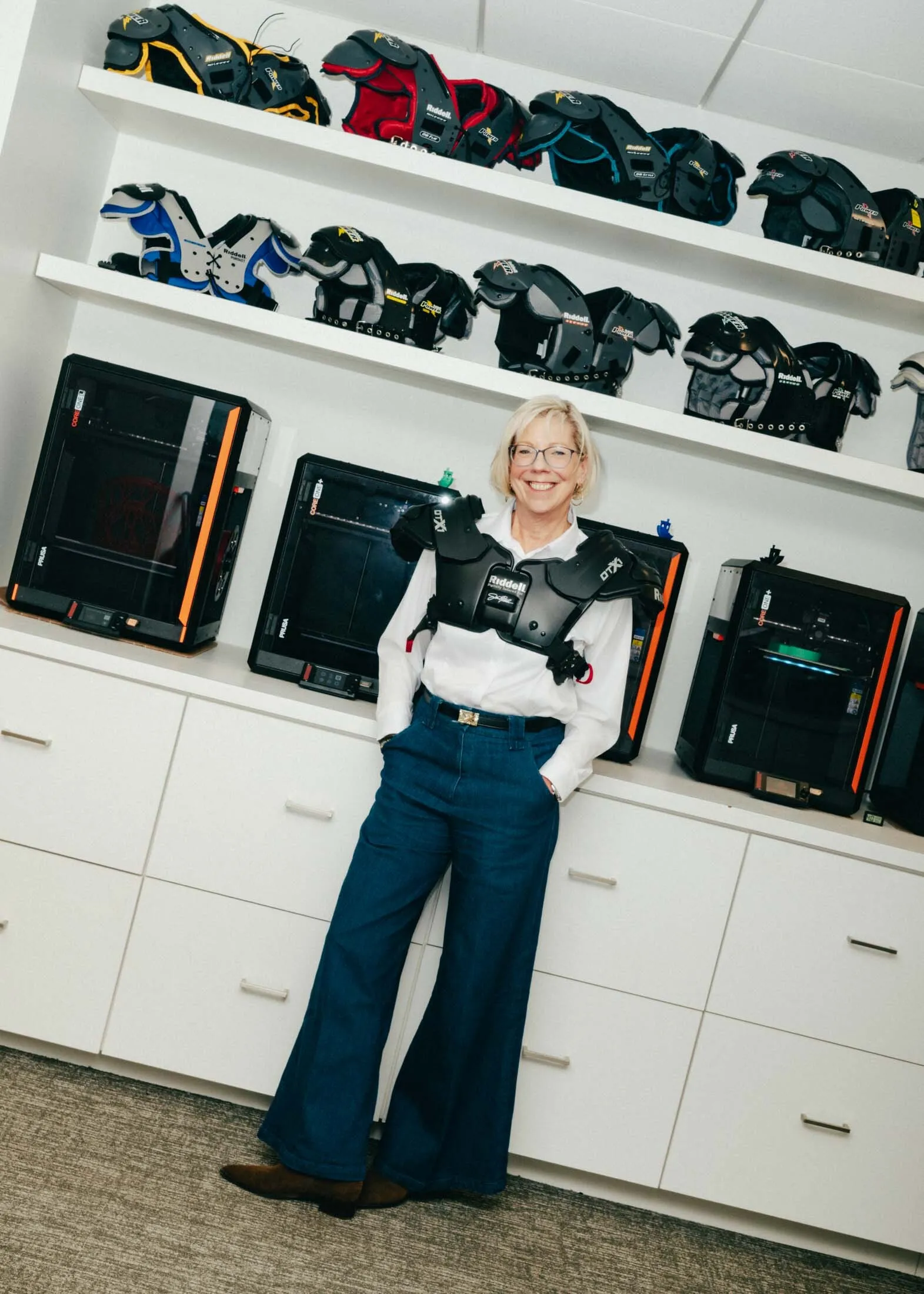
Riddell CEO Allison Boersma. Photographer: Lyndon French for Bloomberg Businessweek
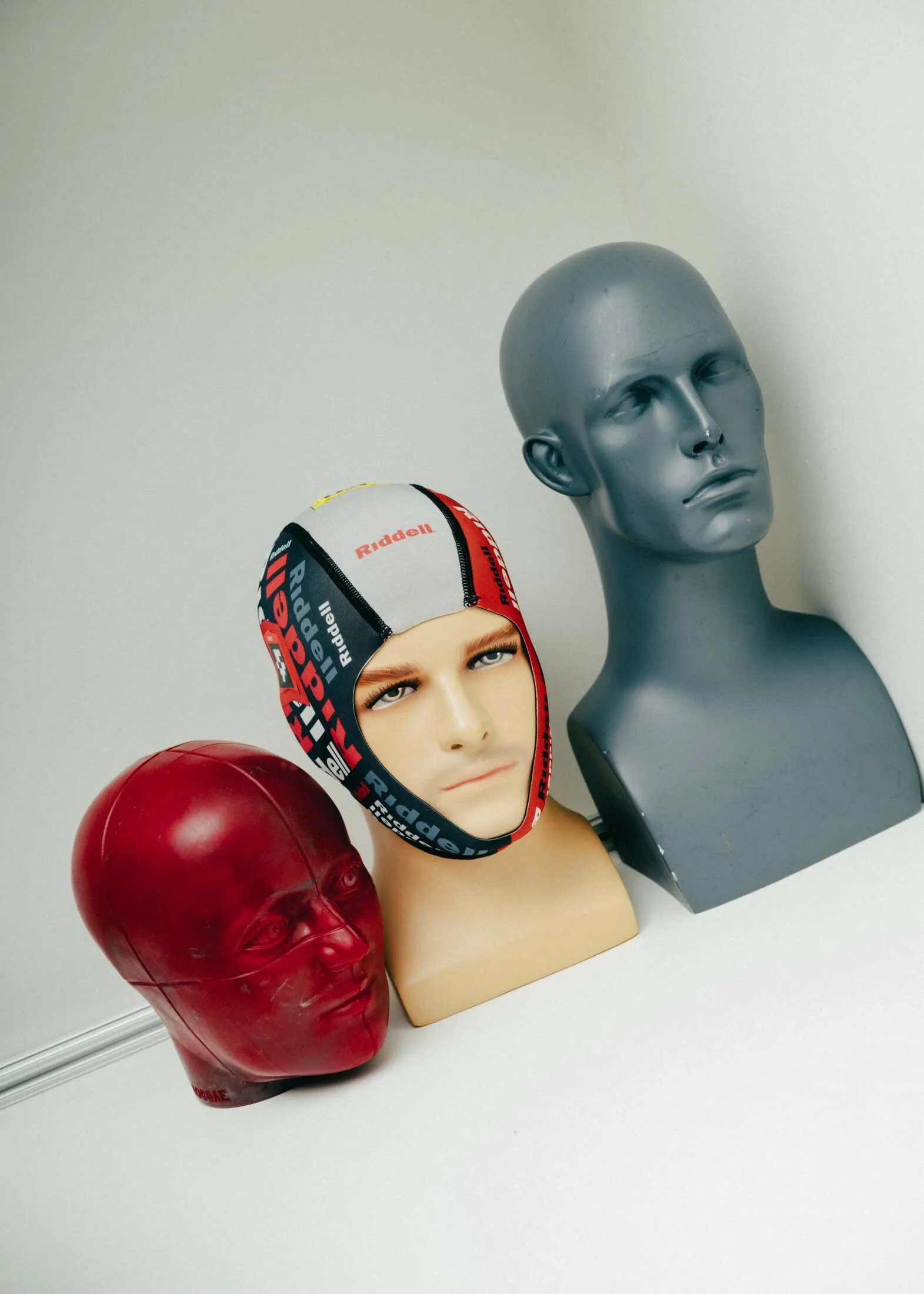
Allison Boersma is cradling a replica of a human head. It’s heavy. “Twelve pounds for an average adult,” says the chief executive officer of the world’s largest manufacturer of football helmets, grinning like a kid at a science fair. “Isn’t that crazy?”
Boersma, who after 16 years at Riddell Inc. became its first female CEO last year, is showing me around the company’s research and product development lab. Here, on the first floor of its unassuming headquarters near Chicago, engineers have simulated more than 20 million hard tackle impacts. The dummy head in her hands is one of many clobbered for their tests.
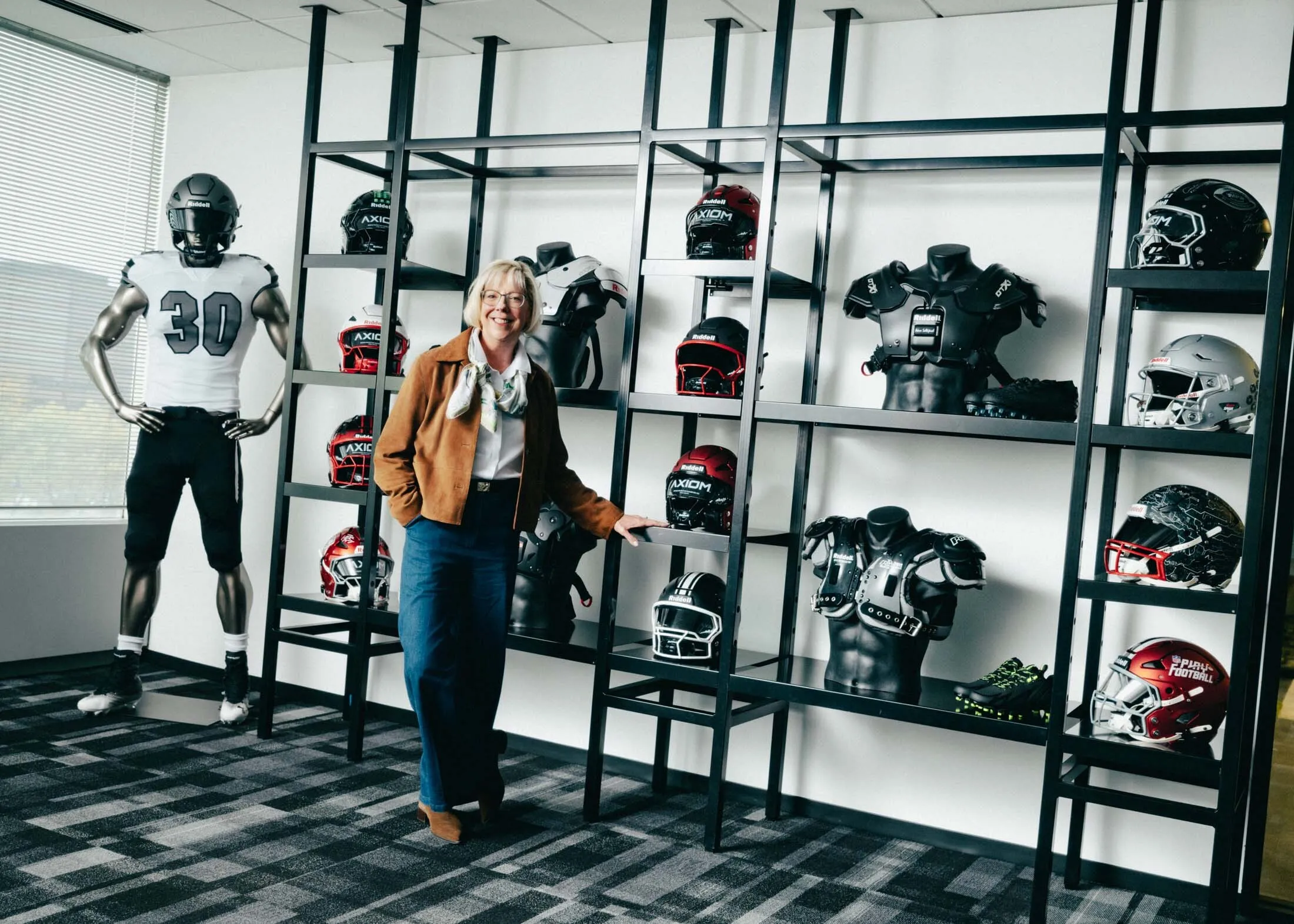
Outside of American football, Riddell may not be a household name. But inside, it’s king. Nearly 73% of National Football League players and 89% of those competing at the top tier of college football wear Riddell, the company says. The private company employs 1,800 people, with annual sales in the “mid-nine figures,” Boersma says, and its products — besides helmets, there are shoulder pads, jerseys, jockstraps and more — pepper professional, college and youth fields across the US. Riddell also has the only NFL license to produce collectible helmets. That’s no small thing: Collectibles, a growing market, represent 20% of Riddell’s business, and they can retail for around $1,600 apiece. “We say, ‘We are football,’” Boersma says. “There isn’t football without us.”
But life at the top can be treacherous. Riddell is so dominant, claiming more than 70% of the overall football helmet market, that it regularly fends off antitrust accusations. Last month it was sued by the Mississippi school district that produced Brett Favre for alleged bid-rigging, something the company declined to comment on. “We’re not a monopoly,” Boersma says matter-of-factly. “We have competitors, and they’re strong competitors.”
Riddell has also fought liability lawsuits, many in the form of class-action suits, from thousands of professional and amateur football players related to the safety of its helmets, and it has won the majority that have made it to trial. Still, a simmering social debate over head injuries has caused some Americans to wonder, per the headline of a 2026 New York Times article, if football is “doomed.” According to a widely shared study, 1 in 4 NFL players who died from 2016 to 2021 had the degenerative brain disease known as chronic traumatic encephalopathy. (A more recent study from Boston University estimated that about 75% of former NFL players who died from 2008 to 2023 had CTE.)
“That study reminds us why our work matters,” says Boersma. “Football is changing — and it should. I believe the game has a strong future, and we have a responsibility to help shape it.”
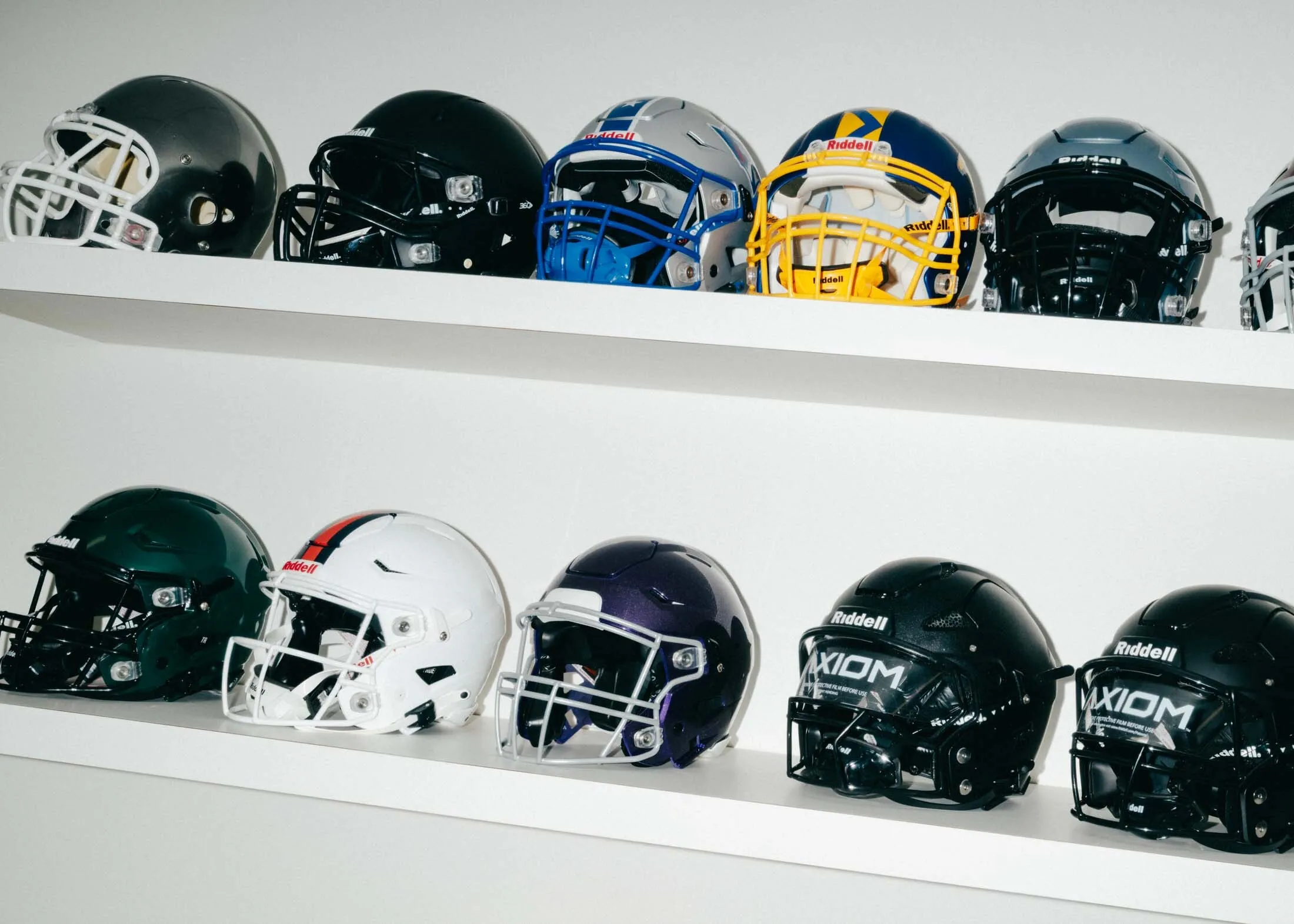
When John Tate Riddell formed the company in 1929, it was not for making helmets but shoes. Riddell, a high school football coach in Illinois, had designed the world’s first removable cleat some years earlier; he went on to invent the first plastic shell helmet, which transformed the young sport. Plastic was a game-changing advancement over leather, the previous standard, which easily lost its shape and did little against the hits that caused head injuries. Over the years the company kept pioneering new components — the chin strap, the face mask, the inflatable liner — essentially birthing the football helmet as we know it today.
Still, early products were primitive, and the injuries continued. In the 1960s, more than a hundred high school and college players died of skull fractures and brain bleeds, according to a 2016 Harvard University study. When national safety standards for helmets finally arrived in the 1970s, they required helmets to absorb the force of a blow that would keep it below a skull-fracturing threshold. Fatalities fell by 74%.
Riddell was the first brand to release a helmet that met the new standards. Yet, players were still getting concussions, and through the rest of the century, liability lawsuits drove many rivals out of business. Faced with a $5.3 million judgment in 1975 that sent its insurance premiums up tenfold, Riddell survived by raising prices, beefing up its legal strategy and solidifying its grip on the pros. In 1989, Riddell struck an exclusive and lucrative deal to become the NFL’s official helmet; other brands could still be worn on the field, but only the Riddell name could be seen emblazoned on the side. In 2002 the company released its Revolution helmet, designed with more padding in response to concussion research; not long after, it introduced its Head Impact Telemetry System (HITS), a configuration of sensors inside helmets that transmit data on hits to medical staff on the sidelines.
The company continued to expand during the Covid-19 pandemic. Although some football seasons were canceled and factories closed, as smaller competitors yet again dropped by the wayside, Riddell was able to pick up market share, says Boersma. To handle the extra demand, the company squeezed out 35% more capacity in its existing facilities and workforce in Illinois and elsewhere. It has since given up some of those gains, mostly among price-sensitive youth customers, but Boersma says it kept most of the customers it had won.
Boersma joined Riddell in early 2009 in the finance department. A native of the Chicago suburb of Lake Forest, she’d competed at the state level in high school badminton before studying accounting at the University of Illinois. In 1991 she was hired by mac-and-cheese maker Kraft and went on to spend nearly two decades there in various finance roles. While there she also earned an MBA from Northwestern University’s Kellogg School. But Boersma wanted a more substantial role. As a mother of two, keeping close to home was a prerequisite. Riddell was perfect.
Boersma’s remit was wider than your typical chief financial officer or even chief operating officer, which she later became. When Riddell opened a large automated distribution center in Rantoul, Illinois, Boersma was tasked with figuring out how to run it. She also spearheaded the commercial launch of Riddell’s InSite system, an upgrade to HITS. Today, InSite comes standard in Riddell’s top-of-the-line Axiom helmet ($1,010), used by more than a thousand football programs — including many of the pros. Back in the testing lab, a technician uses a battering machine to clobber an Axiom-helmeted dummy head. In a Riddell iPhone app, the impact is immediately registered with a score and logged.
We wrap up in the lab and venture into the halls of headquarters, a jubilant Boersma greeting workers by name. At one point, to prove Riddell employees are unusually loyal, she stops by some cubicles to take a poll. “Lisa, how long have you been with the company?” Twenty-two years. “Leah?” Thirty-six. “Virginia?” Twenty-one. “Michelle?” Nearly 10. “Wow, Michelle, you’re the baby!” She turns back. “Is that not insane?”

Since her promotion to CEO in early 2025, Boersma has visited every Riddell facility (two in Mexico, three in the US, one in Canada) and has traveled widely to meet coaches and teams — in Texas, Nevada, California. Pleasing coaches is particularly important in the pigskin business. Mostly, helmets are not sold à la carte in a shop but in bulk directly from brands, and coaches control the purse. “Our customers are not consumers, really,” says Boersma. “It’s coaches; it’s institutional.”
Starting in 2011, more than 4,500 former NFL players sued the league, alleging it had concealed the long-term dangers of head injuries; the NFL settled without admitting wrongdoing but has since paid out more than $1 billion. Riddell, a co-defendant in the litigation, was left out of the settlement. It has since faced more than 100 individual suits from former pros and high school players. In 2013 a Colorado jury found Riddell negligent for failing to warn about concussion risk, awarding $11.5 million to a brain-injured high school player, a portion of which fell on Riddell. (The case remains one of the few jury verdicts Riddell has lost. In 2014, a Los Angeles jury took about 20 minutes to clear it in the case of a high school player left partially paralyzed by a hit; in 2022, a federal judge in Chicago threw out a mass suit by former high school players, saying they had come “nowhere close” to proving their claims.)
The Federal Trade Commission concluded in 2013 that an earlier marketing claim — that the Revolution helmet reduced concussion risk by 31% — wasn’t substantiated. Although it chose not to sanction Riddell because the company had already stopped using the claim, it was certainly lousy PR. Soon after, the NFL ended Riddell’s official helmet deal; at the college level, branding is up to the program. “The company recognizes that lawsuits may be filed. But we also have decades of experience managing litigation and vigorously defend our products when challenged,” Boersma says.
There are inherent risks in sports — “CTE is a serious condition, and no single piece of equipment, including a helmet, can eliminate that risk on its own,” Boersma says — and Riddell has no plans to exit football. But it has been diversifying. The company has moved into the fast-expanding flag football space, which it sees as a gateway to the tackle game. (Flag, with its own growing fan base, will make its Olympic debut in 2028.) Riddell’s flag products include soft-shell headgear, belts and uniforms. Boersma, who recently hired two female flag sales reps, wants to expand further. “We need to do it in a way that’s smart,” she says, “that’s focused on female-specific requirements, not just ‘pink it and shrink it,’” as people in the sports industry sometimes call a common strategy for marketing to women.
Boersma also sees flag as a complement to the NFL’s global ambitions. “If you can grow a lot of excitement around flag and get people into the sport of football, potentially that transitions into broader tackle participation,” she says, adding that Riddell sponsors the NFL Academy’s tackle football programs — the league’s development training for international teens — in the UK and Australia. “If it doesn’t, it could just mean global flag football.”
But for now, helmets — and the hard knocks that make them necessary — are the company’s lifeblood. “Football is a contact sport, right?” she says. “But we are committed to reducing impact exposure in any way possible. It’s top of mind to continue to innovate.”
More In the News